Mostrando las entradas con la etiqueta History. Mostrar todas las entradas

jueves, 8 de diciembre de 2016

Belleza por Todos Lados - Huaca Pucllana

Huaca Pucllana is a pre-Inca archaeological site in the middle of Miraflores, Lima that's only steps from my friend's house. If you're ever in Lima, go check it out.


miércoles, 8 de junio de 2016

Women Shaping Politics Across the Americas

It's been a good week for women. In the States, Hillary Clinton made history as the first female major party candidate for the presidency. In Peru, Keiko Fujimori lost to Pedro Pablo Kuczynski, which is good for all women who are against forced sterilization.

The presidential race in Peru was exceptionally close. Right now the count stands PPK 50.13% to Keiko 49.76%.* Peru has no electoral college, so the presidency is won based on the popular vote.

One thing that helped PPK pull ahead was an 11th hour message from ex-candidate Veronika Mendoza. She won the southern Andes in the first round of elections, in part because she is orginally from there. In fact she is a native of a town you know well by now - Andahuaylillas. On June 1, she recorded a message in Quechua, "Keiko Manan Atipananchu,"** urging supporters not to leave their ballots blank, but to vote for PPK against Keiko. The message was played on radio stations and distributed across social media. And plenty of analysts are saying it was probably a deciding factor in the race.

So there you have it, a woman form a small town may have decided the next president of Peru.


*There is less than 1% of the vote left to be counted, including votes from very rural areas and votes from Peruvians living outside the country.

**Keiko manan atipananchu is the Quechua for the anti-Keiko cry of "Keiko no va." It literally means "Keiko doesn't go," but carries the same basic sentiment as "Never Trump."

sábado, 12 de diciembre de 2015

Andean Barroque Route Promo Video

Two weeks from today 3 regular readers (going by the group code name of Pham Lee) will be in the Quispicanchi on a tour of the Ruta del Barroco Andino (Andean Barroque Route). It's a tour of 3* Jesuit churches that were decorated in a style specific to the Andes known as the Cusco Barroque school. As the name suggests, it's a mix of Barroque and Andean influences. 

The crown jewel of this tour is the church in Andahuaylillas, called "the Sistine chapel of the Americas." You get glimpses of it at 0:16-0:20, and again at 0:47. 


The Ruta del Barroco Andino is a great tour which I recommend. I recommend it for various reasons:
  1. It's a different side of Cusco. Most tourists (myself included) come to Cusco to see Incan ruins. There's lots of them around - Machu Picchu, the Inca trail, Ollantaytambo, Pisac, Moray, Koricancha, and many more. But life in Cusco kept on going after the Spanish conquest. The paintings on the walls of these parishes, espeically the church in Huaro, tell some of those stories. 
  2. It's ethical tourism. The funds raised from the entrance fees to the churches, and from the gift shops, go to support the social programs of the Jesuits. These are the programs my community mates Erin, Victoria, Jacqueline, Lucía, and Lauren all have worked with. Programs include a very cheap hot lunch program for students, library and homework help, a play room with special programing designed to encourage kids to play and let loose their creativity (something that often isn't valued in the home). All proceeds from the gift shop are split evenly with the producers of the items. Unlike with a lot of the souvenirs you can buy in Peru, you can know that money spent at these shops is supporting local people.
  3. It's just beautiful. You can see a lot of churches in Peru. The 3 churches in Quispicanchi stand out to me because they aren't massive cathedrals. One of them is quite small. But each parish holds a unqiue beauty that tells it's own story. Andahuaylillas has the most gold leaf, but Huaro has one of the most impressive murals I've ever seen.
  4. You can stop in the South Valley afterwards for great Peruvian food.
So if you're ever in Cusco and want to see somethign besides Incan ruins, check out the Ruta del Barroco Andino. If you're lucky it might be a feast day and you could see some of the traditional dances in one of the plazas.
So if you're in Cusco


*Technically it's a 4 church tour. It usually starts at the Jesuit cathedral in Cusco. But since we'll be in Andahuaylillas already, and Pham Lee has already seen the Jesuit church in Cusco, we'll only be doing the 3 chuches in Quispicanchi.

jueves, 27 de agosto de 2015

St. Ignatius, a history

Since we're focusing on Saint Ignatius in my religion classes, I thought it'd be a good time to bring up St. Ignatius on my blog. He's important because he's the founder of the Jesuits, and (for those who forgot) I'm in the Jesuit Volunteer Corps. He's also important here because he's the patron saint of FyA 44. Rather than write another history of St. Ignatius's life, I'm stealing the one from Xavier University's webpage.


viernes, 31 de julio de 2015

How Peru Became Independent

DESDE ESTE MOMENTO EL PERÚ ES LIBRE E INDEPENDIENTE POR LA VOLUNTAD GENERAL DE LOS PUEBLOS Y POR LA JUSTICIA DE SU CAUSA QUE DIOS DEFIENDE. ¡VIVA LA PATRIA!, ¡VIVA LA LIBERTAD!, ¡VIVA LA INDEPENDENCIA!.José de San Martín. Lima, 28th of July of 1821
FROM THIS MOMENT PERU IS FREE AND INDEPENDENT BY THE GENERAL WILL OF THE PEOPLES AND FOR THE JUSTICE OF ITS CAUSE WHICH GOD DEFENDS. LONG LIVE THE FATHERLAND! LONG LIFE FREEDOM! LONG LIVE INDEPENDENCE!

Being from the original New World colony that sprang up in revolution against a European power, I had assumed that the story of Peru's independence would be similar to our own story in the fundamentals. Basically the colonial government gets too pushy, the people start to push back, hostilities break out and after a couple years of war a new country is formed. But that's not how it went in Peru.

martes, 28 de julio de 2015

Viva el Perú!

It's Independence Day in Peru. Here's the national anthem for your listening pleasure and cultural education. I even found you a video with the English translation!


I dunno if Google is marking today in the US, but here's the doodle that I see:

sábado, 4 de julio de 2015

Happy 4th! (and Mes de la Patria)

Happy Independence Day to all. We're throwing a 4ht of July party on the lawn behind the retreat house at the parish in Andahuaylillas. There's plenty of chili and cornbread so come on by.

Also, July in Peru is Mes de la Patria (Month of the Fatherland). Independence day is the 28th. So this month we'll look at the history of how the first Spanish colony in South America became the last to declare independence.

jueves, 11 de junio de 2015

Corpus Christi

Corpus Christi is the feastday that most US Catholics don't really think about. If you took Latin, you know that Corpus Christi means "the body of Christ." If you didn't take Latin, then you still know what it means because I just told you. It "emphasizes the joy of the institution of the Eucharist."*

In Cusco, Corpus Christi is a whole different matter. Within the city, all the statues of the saints from the various parishes are brought to the Cathedral. Last Thursday (June 4) the saints were carried in procession around the streets ending in a circuit of the plaza and carried back into the Cathedral. There's music, there's costumes, and the plaza is absolutely packed. School is also canceled. As one of the fourth grade teachers said "Corpus is Corpus." You just can't stand in the way of the tidal wave of devotion and celebration.

Source
Where does this tradition come from? That's always the question when looking at foreign traditions. Do you remember the way the Incas treated their dead rulers? They mumified them and paraded them around the plaza for important events like the inauguration of a new Inca. The Spanish put a stop to that as soon as they could, and saint statues replaced mummified Incas. Urban legend claims that the saint statues were constructed around the mummies, and that they are still to this day parading around the kings of a defeated empire. While this probably isn't true (and should be really easy to prove or disprove using some x-rays), the connection between the devotion and traditions surrounding the dead Incas and the devotion and traditions surrounding images of the saints is clear.

I missed out on the celebration, but the good thing about a 2 year committment means that I have another chance next year.

Source
The food tradition of Corpus Christi is to eat a plate called Chiri Uchu. The name translates to "cold and spicy." It's comprised of ingredients from each of the 4 regions of the Incan empire. There's chicken, guinea pig, sausage, cheese, Andean popcorn, seaweed, fish eggs, a torreja (a fried pancake-like thing) and rocotos (very spicy peppers often used in ceviche dishes). The sixth grade classes had a party for Corpus Christi on Wednesday, and gave a plate to each teacher, so I got to have a taste of the pinancle of Andean cuisine. Overall I liked it, but the seaweed was hard to chew through.


*From Wikipedia page on Corpus Christi

domingo, 7 de junio de 2015

Señor de Qoyllorit'i

Sr. de Qollor Riti
Source
How to explain Señor de Qoyllority? I don't really know. That's partly because I was unable to participate in the recent pilgrimage. That's also party because I don't think I'll ever understand Andean spirituality deeply enough to explain it to another person, let alone to feel like I get it myself. But I'll give it my best shot and if you want to know more you can ask Google to translate the wikipedia page.

Here's the official story: In 1780 a Quechua shepard boy named Mariano Mayta who lived way up in the mountains made a new friend. His new friend was a mestizo (mix of white and indigenous) named Manuel. Mariano's father was pleasantly surprised with the increase in income that his son's friend brought on the family and decided to buy Manuel some expensive new clothes from Cusco. So they headed to Ocongate.* The priest of Ocongate was looking for Manuel one day. When he found him, Manuel transformed into an image on a rock. Thus began a Quechua tradition of devotion to the image. The Catholic Church, a masterful organization when it comes to evangelizing by mixing in elements of a different culture, claimed that it was an image of the crucified Christ. Thus the image became known as el Señor de Qollorriti. Qoyllur is Quechua for star and Riti is Quechua for snow. So an English translation could be Our Lord of the Star in the Snows.


Source
El Señor de Qoyllur Rit'i is perhaps the biggest religious festical in the Southern Andes. The pilgrimage draws over 10,000 people. The most extreme version of the pilgrimage is a 24 hour walk. One of friends did the pilgrimage. He told us that he put his pack on a horse. The horses went a different route than his group. He sorely regreted giving the horse his pack when it started to rain and he didn't have a raincoat. The rain lasted an hour and a half. It's really cold high up in the mountains. But that's how strong the devotion to Señor de Q'oylloriti is.

After the pilgrimage, the Qollas (men who dance for the pilgrimage) danced outside the parish in Andhuaylillas. Here's some pictures. Unfortunately I only had my iPod with me, so they're not as high quality as usual.


The men come out in pairs and whip each other.
The idea is that it cleanses for the year to come. 
When it starts to get intense, someone else steps in to end the whipping.
The two men then hug each other and go back to their lines. Then two
more men come out and repeat the ritual.
PS - At some point while reading this you may have commented "Boy, Ben's really failing in the spelling department today." While there may be some English typos I missed, all the different spelling of Señor de Qoyllorit'i are correct. It's a Quechua name. As you may remember, Quechua doesn't have a standardized spelling the way English and Spanish do. All the different spellings I used are spellings I've seen on taxis, storefronts, and banners.

*Remember Ocongate? It's where I was in February helping out at the academic summer camp.


sábado, 30 de mayo de 2015

Túpac Amaru and Religion

When I studied in Lima, my favorite class was 'The History of the Church in Latin America and Peru.' It was taught by Fr. Jeffrey Klaiber, S.J. Among the many topics covered were Messianic Movements, and we looked at Túpac Amaru's rebellion in that context. It would be a disservice to my late professor's memory to neglect the religious aspect of Túpac Amaru II's rebellion when discussing him here.

You may have been wondering (but probably weren't) how it was that a man claiming to be the Inca lead an army right through Andahuaylillas and yet there is still a overwhelmingly ornate church here. It's because Túpac expressly forbid the killing of priests and the destruction of churches. This was despite the fact that the official church opposed him. Yet many priests sympathized with his cause of protecting indigenous people from the crown's abuses.

For his part, Túpac Amaru never publicly condoned or repudiated the Catholic Church. But he did use Christrian as well as Andean symbols in his movement. Professor Klaiber taught that it was most likely that Túpac Amaru used Incan and Christian symbols in his campaign primarily to attract followers to his cause. The Spanish, and in particular the Jesuits, had been around long enough to attract many of the indigenous people to Christian beliefs.

In class we ended up defining the Great Rebellion as a “quasi-messianic” movement. Túpac Amaru comes from the same tradition as leaders like Moses, David, and Solomon, who used religious reasons to justify their movements on behalf of their people. Túpac Amaru mixed Christian and Incan religious elements to justify his rebellion.


As a final note from our study of Túpac Amaru with Professor Klaiber, anyone seriously studying Túpac Amaru has to be very careful about their sources. Just like with the Incas, most of our knowledge about Túpac Amaru comes from Spanish writers. Since they were the people who killed him and then quartered his body, they tend to have a bit of a bias. You always have to read between the lines when reading accounts of conquest and colonization.

viernes, 29 de mayo de 2015

Prominent Peruvians: Túpac Amaru II and th Great Rebellion

Do you really need a caption to tell you
this is Túpac Amaru II?
Source
May 18 was the anniversary of the death of Túpac Amaru II. He's a big deal in Peruvian history; and he's an especially big deal in Cusqueñan history. Who was he? Why's he so important? And why does he have the same name as the rapper? Fear not, dear reader, all your questions will be answered.

Túpac Amaru II was born in Surimana. His birth name was José Gabriel Condorcanqui. Before he found his calling as a revolutionary hero, he was a muleteer/trader. That meant he did a lot of travelling around the Southern Andes and had built up a network of connections which helped him in his role as a revolutionary. He was the cacique (chief) of the Tungasuca area. In 1760 he was married to Micaela Bastides Puyucahua. They had some kids, and a fairly normal life. Then he declared himself Inca and began a campaign to kick the Spanish out of Cusco. It's this last part of his life that makes him such a big historical figure.

sábado, 23 de mayo de 2015

Belleza por Todos Lados: Incan wall


There's no mortar holding these stones together. They're all cut perfectly to fit with each other and be held together by gravity. This technique protected buildings during earthquakes.

jueves, 16 de abril de 2015

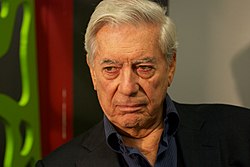
Prominent Peruvians: Mario Vargas Lloas

If, like Victoria, you've studied Literature, you might recognize Mario Vargas Llosa as the winner of the 2010 Nobel Prize for Literature.

If, like me, you studied Latin America, you might recognize Mario Vargas Llosa as the man who lost the 1990 Peruvian presidential election to Alberto Fujimori, the man who would go on to become Peru's most recent dictator.

If you're like most US Americans, you have no idea who Mario Vargas Llosa is. But that's ok, because I'm going to tell you. Vargas Llosa is one of Latin America's most prestigious novelists and essayists. He first became famous in the 60s and his biggest novel of that era was Conversation in the Cathedral. This native of Arequipa and Lima (the two biggest cities in Peru) has written novels in various genres including historical, murder mystery, political thrillers, and comedies. 

martes, 17 de marzo de 2015

Happy Day!

Happy St. Patrick's Day to all my fellow Irish descendents. There's no Guiness or Irish Whiskey in Andahuaylillas so drink an extra (or 2 or 3) for me.

Source

And happy anniversary of being elected to Pope Francis! Peruben Fun Fact: I was in Peru when Francis was selected. I remember we were walking back to the study abroad office from lunch at a chinese restaurant and Logan got a text message. He looked up at me and said "Habemus papam." Francis is a rockin Pope. If you need convincing, see this list of 21 Reasons Pope Francis is Everyone's Person of the Year

Source
Source


sábado, 14 de marzo de 2015

Women's History Month: Saint Matilda of Ringelheim (aka Saint Maud)

Doesn't it look like she's telling the king what to do?
Mathilda was born in 895 in present day Germany. She grew up in Herford Abbey, where her grandmother was the Abbess. She was married to Henry, the Duke of Saxony who in 919 became King Henry. Queen Mathilda was very generous with state resources, and her husband supported her efforts on behalf of the poor and the imprisoned. When he died in 936, her son Otto became king. Mathilda established Quedlinburg Abbey in Saxony in memory of her husband. In 966 her granddaughter, also named Mathilda, became the first abbess.

At first Mathilda stayed at court as Queen Mother. But in part of a growing rift between the King and one of his brothers, Mathilda was denounced for spending too much from the royal treasury on charitable activites. She was eventually invited back to court at the urging of King Otto's wife, Queen Edith.

Mathilda died on March 14, 1968 and is buried in Quendlinburg Abbey.

Saint Mathilda is recognized for her generous almsgiving and devoted prayer life. According to one biographer she would sneak away from her sleeping husband in the middle of the night to go pray. She is most recognized in Germany.

Image Source

viernes, 6 de marzo de 2015

Women's History Month: Saint Colette

Today, as I learned in my research for this morning's post, is the feast of Saint Colette. I keeping with
the suggestions I made this morning, I thought I should find out who she is and why she's a saint.

Life
Nicole Boellet was born on January, 13 1381 to Robert Boellet, a carpenter at the Benedictine Abbey of Corbie, and Marguerite Moyon. According to Saint Colette's biographers, Marguerite and Robert were in their 60s when Marguerite gave birth to Nicole. They had prayed to Saint Nicholas - yes, that Saint Nicholas - for a child and named the baby after him. There wasn't much for a poor girl to do in the late 14th century, so when her parents died she joined the Beguines (a lay religious order). Colette decided that the Beguine life wasn't intense enough for her so in 1402 she joined the Third Order of St. Francis (another lay religious order). But that wasn't intense enough either. After four years with the Third Order, she followed the call to reform the Second Order of St. Francis (so she basically upgraded in religious life).

Under the authority of the Antipope* Bendict XIII (it was a hard time for Catholicism - there were two men claiming to be the pope at the same time, which might seem normal since we have two popes now, but these guys weren't friends, and both wanted the keys to the popemobile), she joined the Order of Poor Clares (contempletive nuns connected to the Franciscans). Between 1406 and 1412 she founded a number of new monestaries and brought the Order of Poor Clares back to its roots. The monestaries who followed her reform had to follow her prescriptions of barefootedness (sounds like the order for me!), extremem poverty, perpetual fasting, and abstinence (I spoke too soon).

She died on March 6, 1447.

Source
Miracles
Saint Colette is credited with two miracles in her Wikipedia article. In the first, she stopped at a friend's house on the way to Nice. Her friend was having major difficulties in childbirth with her third child (and probably less than pleased to have old friends stopping by looking for a bed and supper when she was busy trying to have a baby). Saint Colette "immediately went to the local church to pray for her" (and probably to remove herself as a nuissance). The baby girl was born healthy and the mother survived. She credited Colette's prayers.

The second miracle came when a local peasant had a stillborn child. The father was concerned for the baby's soul.** The local priest refused to baptise the dead baby and told the father to go to the St. Colette's monestary. When he arrived there, Colette removed the veil that the Antipope had given her and had the father wrap the child's body in it and then bring it back to the priest. The father obeyed and by the time he arrived back at the parish the baby was alive and crying. The priest went through with the baptism.

Fun Fact
For all you folks reading this at home in Boston, you can drive by a Poor Clares cloister in West Roxbury. It's on the rotary connecting Centre Street with the Arborway (near the front gate of the Arboretum).


*Antipope=favorite word I learned this week
**In the Middle Ages it was believed that unbaptised babies couldn't go to heaven. They thought God was a lot meaner and more unfair than we think he is. But maybe, since the Middle Ages were such a sucky time to be alive, that makes sense.


sábado, 28 de febrero de 2015

The Incas: Why Did They Lose?

Did you think we were done with the Incas? I have been neglecting them lately. This is it. The last post about the Incas. I hope you learned a few things from this series, I know I did. This post isn't so much history as analysis, because after all, history without analysis isn't all that useful. 

Why did the Incas lose? From the perspective of the present, their defeat can seem obvious and inevitable. After all, pretty much the same thing happened all up and down the American continents when European colonizers arrived. But it must have been surprising for the Incas and their subjects. After all, they were the most powerful force on the continent.

Charles C. Mann offers four key points the contributed to the Incas' defeat: Technology, Factionalism, Military Tactics, and Disease.

jueves, 19 de febrero de 2015

The Incas: Ransom and Reward

Atahualpa wasn't stupid. While he may not have realized the power of the Spanish cannons and
horses, he knew what they were after: precious metals. The conquistadors weren't seeking gold and silver for their own use. In order to gain prestige back home, they had to bring back goods for the crown. There's lots of great food native to the Americas that would go on to change European cuisine (tomatoes and potatoes to name a few), but food can spoil. Gold has the virtue of not spoiling and being very valuable in Spain. Thus men like Pizarro sought it in order to gain favor with the Spanish crown.

As the immortal god-king of most of the Andes, Atahualpa had a lot of gold and silver at his disposal. It was not as valuable to the Incas as it was to the Spanish. So Atahualpa made an impressive offer to his captors: he would give them a room 22 ft by 17 ft filled with gold and two more filled with silver in exchange for his freedom. Pizarro agreed.

The city of Cusco was stripped of almost anything gold or silver. Caravans of llamas transported Cusco's precious metals to Cajamarca from December 1532 to May 1533 when the price was fulfilled. The gold and silver was melted and sent back to Spain. “To show his thanks, Pizarro reneged on his promise and ordered Atahualpa garroted in the Cajamarca town square” (Adams). Like we established earlier, Pizarro was a bastard.


Pizarro lead his forces to Cusco and took the palace for himself. He began to rule through the puppet king, Manco Inca.


miércoles, 11 de febrero de 2015

The Incas: Captured in Cajamarca

November 16, 1532 is the day the Inca Empire began to fall to the Spanish. 

Atahualpa was aware of Pizarro's landing in Tumbez thanks to his messenger network. He had only recently triumphed over his brother in a was of succession and, understandably, did not accurately access the threat the small Spanish force posed to his power. He said that he planned to "sacrifice some of the Spaniards to the sun and castrate others for service in his household and in guarding his women." Unfortunately for him, that's not how things went down.

On November 16, Atahualpa arrived in the town square of Cajamarca with thousand of unarmed attendants to meet with Pizarro. A Spanish priest presented the Inca with a Christian breviary (religous book). Atahualpa, who may never have seen writing before (the only known Incan system of record keeping involves complicated knot tying in ropes) threw the holy book aside. The Spanish, being good Christian men, used that as an excuse to attack. They fired their cannons and the calvary, which had been hidden behind buildings, charged out into the square. In the confusion, Atahualpa was captured. The capture of the Inca was Pizarro's main objective. He had learned from his cousin Cortés's success the power of capturing or killing the monarch. Because the Incas considered the emperor to be a god, they couldn't just pick a new ruler. Pizarro would use that to his advantage, and later install a puppet government subserviant to the Spanish crown. 

And in so, in just one afternoon, 168 Spanish soldiers toppled an empire.

A oil painting by the Peruvian artist Juan Lepiani
depicting the battle of Cajamarca. Source


martes, 10 de febrero de 2015

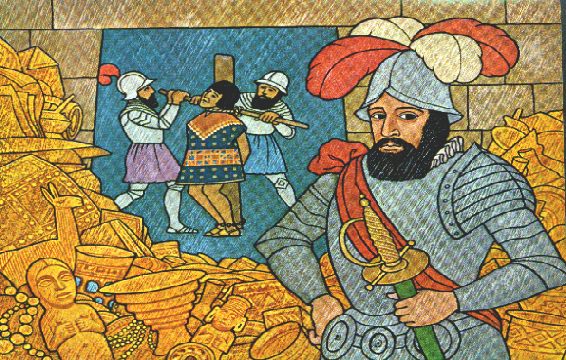
The Incas: Their Conqueror, Francisco Pizarro

Who defeated the Incas? Hopefully anyone who has taken a world history class knows enough about European colonial holdings in the Americas to say with certainty that it was the Spanish. To be more specific, the Incas were conquered by Francisco Pizarro and a force of 168 soldiers. Yes, it was really that small. So who was the man who lead such a small force to conquer the greatest empire in South America?